
Fairest
 By Melf
Ongoing
By Melf
Ongoing
Chapter One of an ongoing retelling — more chapters to come.
Chapter 1: The Thorn and the Rose
The Queen sat alone in her chamber, surrounded by silence so complete it seemed to press in from the corners of the room.
Dusk spilled across the floor in long, bruised shadows. The shutters had been drawn early to keep the light from fading her silks, or so she claimed. In truth, she could no longer stand the way the golden hour touched everything in the castle but her.
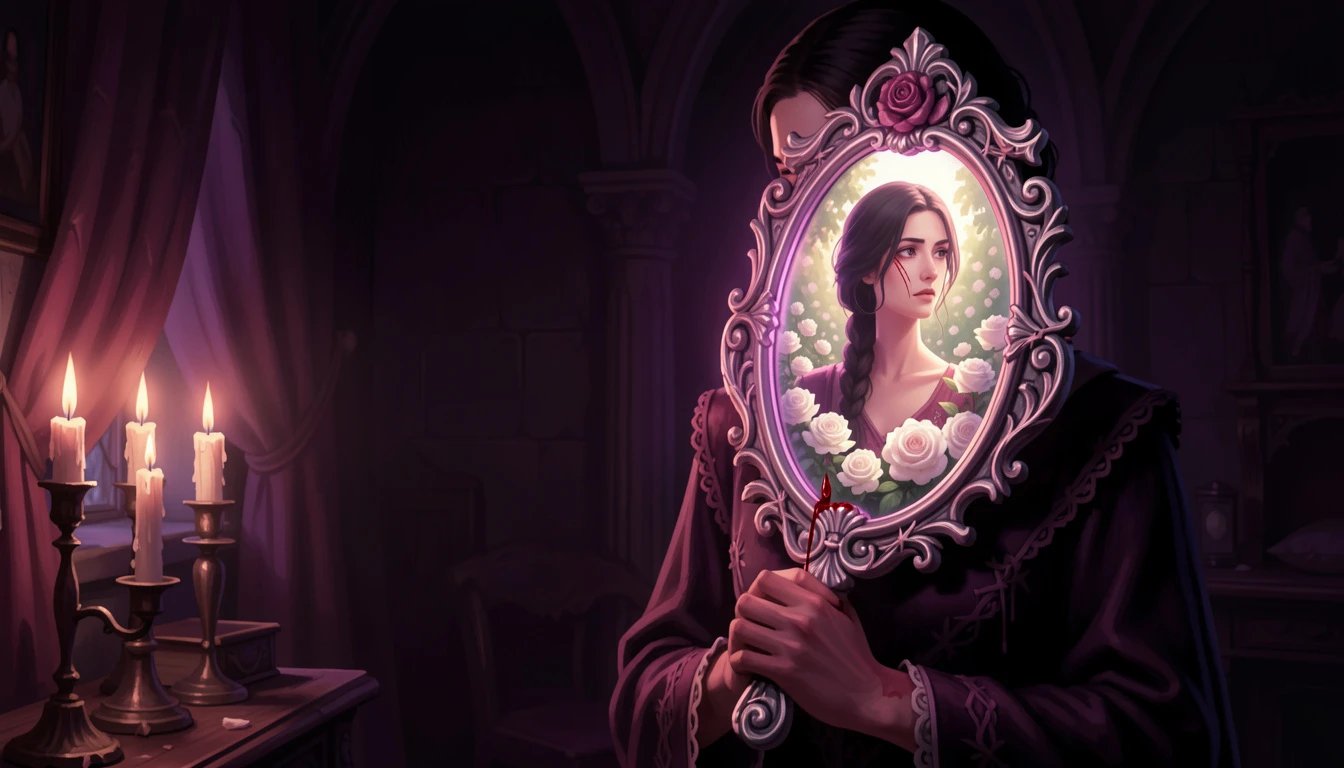
In her lap lay a black velvet wrap, folded precisely, as if it might bite if handled carelessly. She unwrapped it with the slow reverence of a priestess revealing a relic, and there it was: the mirror.
No larger than her hand, carved of dark wood so old it shimmered with oil, chased in silver so fine it had grown dull with age. The silver curled into vines along the back, winding down into the shape of a single rose at the base of the handle. Nestled among its petals were three thorns—real silver, sharp as memory.
She held it up, examining her own face in the glass.
Still beautiful. Of course.
But—
There, just at the corner of her right eye. A single line, soft as a crease in silk. Not deep. Not always visible. But there.
And above her temple, near the crown—was that a gray hair, or only a trick of light?
She drew in a slow breath. Not deep enough to be a sigh.
No, not yet.
Her thumb found the rose at the mirror’s base. She turned it slightly, until one silver thorn caught the candlelight. Then, deliberately, she pressed her flesh to the point. The pain was sharp but clean. A single drop of blood welled up, dark and glistening.
She pressed it to the rose and gasped as the blood flowed into the silver flower, breathing life into it, cold metal pulsing with crimson vibrance.
The mirror shimmered. Darkened. The reflection vanished, and in its place: vision.
There she was.
The girl.
The image sharpened in a heartbeat, as if the mirror had waited for the Queen’s blood just to reveal her. Pale skin without flaw. Dark hair twisted into a braid, imperfectly done—as if by handmaidens with trembling fingers. Lips unpainted. Cheeks with no rouge. Eyes soft, half-lowered, not quite looking at anything.
She was not looking into a mirror. She never did.
The Queen’s fingers tightened around the handle. A familiar tension rose behind her eyes.
That girl had not changed. Not in years.
She had passed from girlhood into womanhood with the same grace that spring becomes summer: natural, inevitable. But now? Time had simply stopped. There were no signs of its touch. No softness, no fading. She had remained in the prime of her beauty for nearly a decade, as though sealed in it. As though chosen.
And still, she never admired herself. Never painted her face. Never asked how she looked. Her chamber held no mirror. The handmaids told stories, always quietly, about how she preferred their judgment to her own. That she didn’t like her reflection. That she trusted their eyes over the glass.
She had no need of it.
The Queen looked back down at the mirror.
The girl was smiling now. At someone off-frame, unseen by the Queen. Her expression was gentle, warm—not seductive, not practiced, but deeply, maddeningly sincere.
That smile had made guards forget their post, had made lesser nobles blush like boys. It didn’t matter who. Everyone loved her.
The Queen remembered when that had been her gift.
She had never been “sweet,” no. But admired? Feared? Worshipped, even? Yes. And not just for her beauty—for her mind, her taste, her presence. The things that lasted.
Or should have lasted.
She looked at the glass again.
The girl had tilted her head back, letting the wind pull loose strands of hair from her braid. She looked as if she belonged in some old ballad or dream, timeless and untouched.
The Queen gently turned the mirror face-down on the velvet, covering the rose with the edge of the cloth.
She had once used the mirror to speak across oceans. To spy on rival houses. To glimpse a lover’s face before battle. The blood price had always been small. It had always been worth it.
And now?
She bled for this.
To look at a girl she could never match, never trust, and never be rid of.
Her stepdaughter.
The last thing her husband ever gave the world.
The Queen stood at the narrow window slit, high above the courtyard, her fingertips resting against the cold stone sill.
Below, the garden glowed with early evening. The white roses had begun to bloom in earnest, their petals catching the last of the sun’s light like small fallen stars. She had ordered them planted the year she was crowned, an aesthetic tribute to peace and purity.
Now they belonged to someone else entirely.
There—moving through the rows, skirts brushing the gravel paths, hair unbound except for a single, lazy braid—she walked.
No escort. No attendants. A linen dress, simple and soft, hugged her figure without effort. The color suited her—no dyes or gold thread, just cream and shadow and that unsettling, eternal skin.
The girl lifted her face slightly, as if scenting the air or listening to something distant. The breeze teased loose strands from her braid, and she didn’t bother to fix them.
Three courtiers passed her along the path. Two men, one young, one old, and a woman in burgundy silks. They dipped their heads instinctively, as if compelled. The older man smiled before he caught himself. The younger barely managed a bow, gaze clinging to her face. The woman looked on with tight lips.
The girl offered them nothing but a faint, distracted nod.
She continued toward the fountain at the garden’s center. At its edge, a stable boy stood frozen, a fallen bucket at his feet, water darkening the gravel.
He couldn’t have been more than ten.
He saw her and panicked, bending to retrieve the bucket, fumbling with the handle. She knelt beside him, calmly, as if he were a visiting lord rather than a child covered in dust and horsehair.
The Queen couldn’t hear their voices from so high up. But she knew the cadence of that girl’s speech: soft, deliberate, always gentle.
She placed a hand on the boy’s, helped him lift the bucket together. He stared at her the entire time, lips parted, forgetting to blink.
She said something—something kind, no doubt—and touched his shoulder. Then she turned and walked on.
The boy stood rooted for a long while after, holding the bucket like it was a crown.
The Queen exhaled slowly. Her fingers left pale marks in the stone.
This was the power that maddened her. Not seduction, not ambition. The girl didn’t ask for attention—she drew it, like breath, like water drawn into root. And once someone looked at her, they never seemed to look away again.
Even the staff had changed.
The guards at the lower gate now stood taller when she passed. The kitchen maids whispered when she favored a dish. The tutors, once loyal to the Queen’s court, now praised her restraint, her intellect, her dignity. The same things the Queen had been scolded for as a child.
But worst of all—the thing that made her mouth tighten and her stomach curl—was that the girl appeared not to want it.
She gave her affection rarely, sparingly, like sunlight on a winter day. But when she did, it transformed people.
And the Queen knew — with bone-deep certainty — that if she were to vanish tomorrow, no one would weep long. The court would mourn her like a cold season, and turn their faces gratefully toward spring.
The girl wouldn’t even need to lift a finger to take her place.
That was the true danger.
And the true insult.
She walked back from the window and sat stiffly at her dressing table. Her hands, folded in her lap, remained still.
The throne was hers.
And she would not be supplanted.
Not by a slip of a girl with soft eyes and foreign blood.
Not by the daughter of a man she had once called husband.
Not after everything she had done to make this kingdom hers.
The Queen lit no candles as night fell. She preferred the dark when remembering things that hadn’t aged well in the light.
She moved through the west wing on quiet feet, long past the hour when servants dared linger. The tapestries here were old—moldering reds and silvers from three reigns ago. Dust clung to the stone like skin to old bones.
She paused before a door she rarely opened anymore.
The portrait hall.
It hadn’t been sealed, exactly—just neglected. The torches along the walls had gone unused for years. Cobwebs cradled the corners. The fire grate was cold.
She stepped inside, the hem of her robe trailing against the tiles.
The gallery stretched long and high, lined with the visages of kings, queens, and favored consorts. Most stared out in grand poses, eyes narrowed, hands gloved or jeweled. She passed them all without looking.
Only one mattered.
At the far end, above a dais draped in a moth-eaten cloth, hung the largest portrait in the room.
It was of a woman seated in a crimson chair, painted in oils so fine the light still glinted off her lips. Her hands were gloved in red as well—deep, blood-colored silk that reached her elbows. Her hair was pinned in a distinctive style, half-coiled, half-loose, like a black flame suspended in air.
Her skin was white—truly white, not merely fair. Not powdered, not affected. But pale in a way that made the shadows bend around her.
The Queen had only seen her once.
She had been twelve. A nobleman’s daughter from the south, brought north with her family to witness a royal wedding. The match had raised some eyebrows — the bride came from far beyond the borderlands, farther than was usual for such arrangements — but alliances were alliances, and it was said she came with rare treasures and old titles.
Still, it had been odd.
The bride arrived with no ladies-in-waiting, no relatives, no ambassadorial entourage—only a single robed figure who spoke to no one and vanished before the wedding feast.
She herself had barely spoken. No toasts, no introductions. Her vows were short and soft, spoken in a low, careful voice.
But her presence—it filled the cathedral like smoke.
From the gallery above, the young girl who would become Queen had watched through a veil of white mesh. She hadn’t understood what unsettled her so deeply at the time. She only knew something felt wrong.
The bride never looked at the crowd. Never blinked. Her gaze remained fixed on the King’s face… or just past him.
And yet, the King had seemed enthralled.
He couldn’t stop smiling. He held her hand the entire time. He kissed her with such reverence that the noble guests had flushed, uncertain whether to cheer or avert their eyes.
That had frightened the girl more than anything else: to see a King, a man, look that undone. Not by passion or drunkenness, but by something deeper. Something that pulled him forward like a tide.
The Queen approached the portrait now, her bare feet making no sound.
She stopped just before the dais and looked up.
Time had not touched the painting. The red gloves still shone. The woman’s eyes stared out—calm and unwavering.
That same expression—unreadable, distant, faintly amused—had been on her stepdaughter’s face just days ago, when the Chancellor’s cousin had tripped over a goblet trying to kiss her hand.
There was a thread between them. Faint, but unmistakable.
Not in appearance, though the girl had inherited her mother’s hair, her stillness, her quiet.
No—it was in how people acted around her.
That pull. That slow unraveling of reason, dressed as affection.
The Queen reached out and touched the edge of the frame. Dust bloomed beneath her fingers.
Her hand trembled, just once.
She remembered the bride had worn no veil.
She remembered how, after the wedding, no one had ever spoken of her homeland again. Not even in gossip. Not even in slander. As if the place had quietly folded in on itself and disappeared.
A generation later, nothing remained of that vanished kingdom but an aging portrait and a daughter who did not change.
The Queen let her hand fall.
She had spent years convincing herself that the unease she’d felt that day had been childish. That it had meant nothing. That the woman had simply been quiet, reserved, private.
But standing here now, looking into eyes painted by a long-dead court artist, she wasn’t so sure.
Perhaps she had known from the beginning—some part of her.
And perhaps that was why her own husband, the King, had looked at her years later and seen only a shadow of what he’d already lost.
The Queen returned to her chambers just after moonrise, the air heavy with a tension she couldn’t name. The corridors had felt too quiet, the servants too still. Even the torches burned low, flickering as though in warning.
She had left the portrait hall with a chill behind her ribs and hadn’t managed to shake it since.
The moon was full. She felt it, even with the shutters drawn. Something about tonight gnawed at her.
She paced the edge of the room once, twice, then poured herself half a glass of wine. It sat untouched on the table beside her, reflecting the fire.
Her gaze drifted — once — to the mirror on her dressing table.
She looked away.
A second glance, longer this time. Her fingers curled against her robe. Still, she turned back toward the hearth.
A third time, her eyes found the mirror and held.
She crossed the room and sat down.
The velvet cloth came away in one smooth motion.
She lifted the mirror and held it in both hands. The wood was warm from the fire’s nearness. The silver rose at the handle caught the light — waiting.
She angled the glass, as if it might stir on its own.
Nothing.
She ran her thumb along the thorn.
It was the same thumb she had pricked the night before, still faintly bruised. She pressed it again, hoping the old wound would give.
A smear of blood surfaced — dull, dried. She pressed harder. A sting. A sluggish bead.
She touched it to the rose.
The mirror stayed still. Just glass.
Frowning, she tried again — pressing harder this time, grinding the thumb into the thorn. The blood came, reluctant and thick.
Still nothing.
The mirror required more than memory. It demanded something new.
Of course it did.
She brought her hand to the rose and deliberately pressed a new finger — her index — against the thorn at its base.
This prick was deeper, sharper than she expected. The silver bit down hard.
Blood welled fresh, a dark bead rolling from her skin down the curve of the handle.
The rose changed.
Its silver petals bloomed red as the blood soaked in. The glass shivered once, clouded, and then cleared with a deep, aching pull — like breath held too long.
The mirror drank.
It clouded, then shimmered — and cleared with that same low, hollow note. Like water inside stone.
She didn’t speak.
She simply thought of her.
The mirror understood.
It showed a quiet room. Stone walls, an old lamp flickering against the dusk.
She recognized it — one of the east-facing studies in the northern wing. Fireless, cold in winter, but filled with light at daybreak.
And there she was.
The girl sat alone in a high-backed chair beside the window, a book open in her lap. Her hair hung loose. She wore a pale robe, unbelted. There was a teacup on the table beside her. Steam no longer rose from it.
She wasn’t reading. Not turning the page. Just… sitting.
The Queen leaned closer.
She watched for a minute. Then two.
The girl didn’t move.
She didn’t shift her weight or tuck her feet under her. She didn’t blink. She didn’t even fidget — no restless hand against her sleeve, no absent-minded brushing of the hair.
Even her breathing… was hard to see. Or not there at all.
The Queen narrowed her eyes, looking closer.
Stillness, by itself, meant nothing. But this wasn’t calm. It wasn’t meditation.
It felt like a painting. Or a doll.
The fire popped behind her, and she jumped.
When she looked again, the girl had shifted. She reached forward, turned the page. Lifted the cup. Sipped.
As though nothing had been wrong at all.
But the stillness lingered in the Queen’s mind, echoing, like something glimpsed in a dream you can’t quite explain.
She sat back, the mirror still open in front of her. Her thumb stung. The blood had dried against the rose.
She had sat like this once before.
That night.
The King’s final night, when the fire had burned low and the chamber doors were kept open only for her.
He had been fading for days — some illness that came quick and strange. No blood, no fever, no name. Just weakness. As though something had been quietly draining him, thread by thread.
She had held his hand. She had whispered to him. She had kissed his brow, brought him water, begged him to sleep.
And still — even with her beside him, even in his final hour — he had only said one name.
His daughter’s.
Over and over again.
Where is she? Is she safe? Keep her close. Watch over her.
As if the woman beside him — the one who had shared his reign, his bed, his war councils — were already gone.
The Queen reached out now and slowly pulled the velvet cloth back over the mirror.
Her hand lingered on it, resting on the silver rose.
The room was quiet, but her thoughts were not.
She had spent years telling herself that the girl’s beauty was luck, her charm a trick of youth. That her silence was modesty, not strategy. That her popularity would fade.
But what if it didn’t?
What if she never aged?
What if she never changed?
There had always been something in her that echoed the woman in the portrait — the red-gloved Queen who had walked down that cathedral aisle with snow-pale skin and eyes like a moonless sea.
The stillness.
The quiet.
The way people leaned forward without knowing they had done so.
She had told herself that time would solve it. That the girl would become a woman, and with womanhood would come flaws, and gravity, and the loss of novelty.
But time had passed.
And the girl had not.
The Queen rose from her chair and crossed to the window.
She opened the shutters, letting in the chill.
The wind rolled in, cold and sharp.
She stood there a long while, staring into the dark.
Tomorrow… no, tonight. Tonight, she would act.
She would send for someone. Not a courtier. Not a spy. Not a man with a crown in his eyes.
She would send for a hunter.
And not just any kind.
The fire in her chamber had faded to embers when a soft knock broke the stillness.
“Enter,” she commanded without turning.
Her steward stepped inside, his expression cautious but obedient.
“Your Highness,” he said, bowing slightly. “You summoned me?”
She gestured toward the heavy chair near the hearth.
“Sit.”
He obeyed, eyes flicking briefly to the velvet-draped mirror on the table.
“I require a favor,” the Queen began, voice low, careful.
“A matter of utmost discretion.”
The steward inclined his head.
“The previous huntsman has failed — or is no longer trustworthy.”
Her gaze lifted, meeting his.
“I need someone who understands the shadows… someone who can track what hides in the places no one dares to look.”
The steward’s brow furrowed.
“And what will he be hunting, Your Highness?”
The Queen smiled thinly, the flicker of something cold in her eyes.
“Something unnatural.”